Showing posts with label Oil painting. Show all posts

November 19, 2017

looking back


While watching a documentary that touches upon the country of Bhutan, I am reminded of Zimbiri, a student from my 2011 Drawing and Painting summer intensive. A search of the internet leads me to the following interview. My reward is seeing her develop past the final project.


Classwork:


June 23, 2015

wet on wet oil painting basics | SIS I Painting '15


Whether you begin with thin washes of color, or work directly on a white canvas, use no more than one or two brush strokes. Any more and you will be mixing colors on your canvas, and lowering their intensity. Stay conscious of what you are doing. If the temptation is there to blend, stand back and first count to ten. Keep a rag handy and wipe the excess paint off your brush. Good habits will keep your colors clean. 


Maya


Jimin


Melanie


Tanisha

June 10, 2015

the first week | SIS I Painting '15


The class begins with drawing. After a lesson on perspective, composition, and values, notice the difference in Jimin's drawing, from the morning to the afternoon session. Her composition fills the page, and by toning the paper she is better able to understand values.  


Jimin


Oil painting starts with a similar process. A wash of color tones the canvas, and a rag, dipped in Gamsol, brings out the light, while paint straight from the tube is the darkest value.


Marisa


Learning to mix colors, keeping them clean, not overworking the brush, and slathering on the paint - like butter - is a challenge for everyone. 


Melanie


July 01, 2014

brush strokes | SIS I '14


Mina wields her brush with super hero power. Or it would seem. This summer brought with it a more thoughtful process  Too much red? quite possibly - a carry over from her previous work. Yet now within a blur of more muted brush strokes and newly mixed color, Mina begins to delve beneath the surface, and negative space is cast as a placid foil to her gravity-defying jabs of boldness. 


July 16, 2013

Angela | SIS I '13


Why squeeze a burgeoning idea onto a single canvas? Sustaining a measured pace with each brush stoke, Angela expands the perimeter of the rectangle: One canvas, then anotherand another, tightly spliced, all seemingly harmonious, and yet with a disquieting use of color and texture. Though her final configuration highlights a haunting narrative, it is delightfully simple to make changes. 


"My experience during this class can be seen through a dualistic perspective. The ideas behind the three paintings I completed during the fourth week revolved around light versus dark and dystopia versus utopia. I'm not completely sure if these were communicated clearly in the works, but I now realize that this idea has been important to me during the full four weeks I've spent here this summer.
I am accustomed to being very detailed, partly because I love getting immersed in the details and partly because I thought that my work could only be good if it were detailed. After my time here, I know now that sometimes having your hand work freely can be more successful in capturing a mood..."
- Angela L., Parsons '13


July 01, 2013

Amelia | SIS I '13


Rejects offer up a dynamic working surface. Try a scrap of wood, with its uncompromising knots, or an already painted canvas, embedded with mounds of color. For one, there is less paralysis than when presented with a stark white canvas. Mistakes are rampant, and for better or worse, a hard fought relationship - both contentious and conciliatory - fuels the painting process. 

Remarkably, there comes a point when
 everything flows. It may be after the third or fourth painting; your grip loosens on the brush; you become conscious of each and every stroke; and your risk-taking mantra - "I don't care" - now makes sense. 


"...The incessant trembling, the fear of failure and self doubt absorbs you. But when you surrender to the carelessness, that's when things start to occur. When every brush stroke and line reflects in the deepest way every fiber of your being. When every image is a question and an answer at the same time, that's when all your doubts have been answered."

                                         - Amelia R., Parsons 2013


June 25, 2013

Leslie | SIS I '13


It is fascinating to see the maturation of a student's work in the course of a four-week intensive. Here an eclectic mix of lines extends from Leslie's figurative gestures to the delineation of an envisioned coastline. 


The lustrous surface on a piece of slag (such as the one pictured) goes further to engulf her terrain. Strong diagonals meld with values - invoking greater depth - even as its jagged edge seemingly continues along a road's circuitous route.


"My most recent painting series was inspired by themes of existence and nonexistence. Influenced by my own experience of great tragedy caused by a natural disaster, I was drawn to the artistic expression of a fleeting and diminishing existence. Having grown up on the southern coast of Louisiana, I have a great appreciation for the wetlands and their unique habitat. Through the exploration of such themes in my art, I have come to the realization that my fascination with the strictly visual components of the wetlands may be linked to their significance in protecting the delicate areas around them. By acting as a sponge and obtaining water, the wetlands prevent flooding and purify the surface water. Furthermore, this series focused on the lines and shapes seen in aerial views of landscapes. 

Throughout the duration of this course my way of approaching my work has changed dramatically. My subject no longer intimidates me. I have built up more confidence in my loose handwork, while simultaneously becoming more aware of the composition. As I gravitate further towards the expressiveness in my work, I have been able to let go of my desire to have complete control. Oil paint allows me to be expressive and free with line, texture and color. I have been experimenting with use of dry brush, giving my lines texture and adding depth by exposing the maps underneath the paint." 
                                                                                    -Leslie Williamson, Parsons 2013 

June 09, 2013
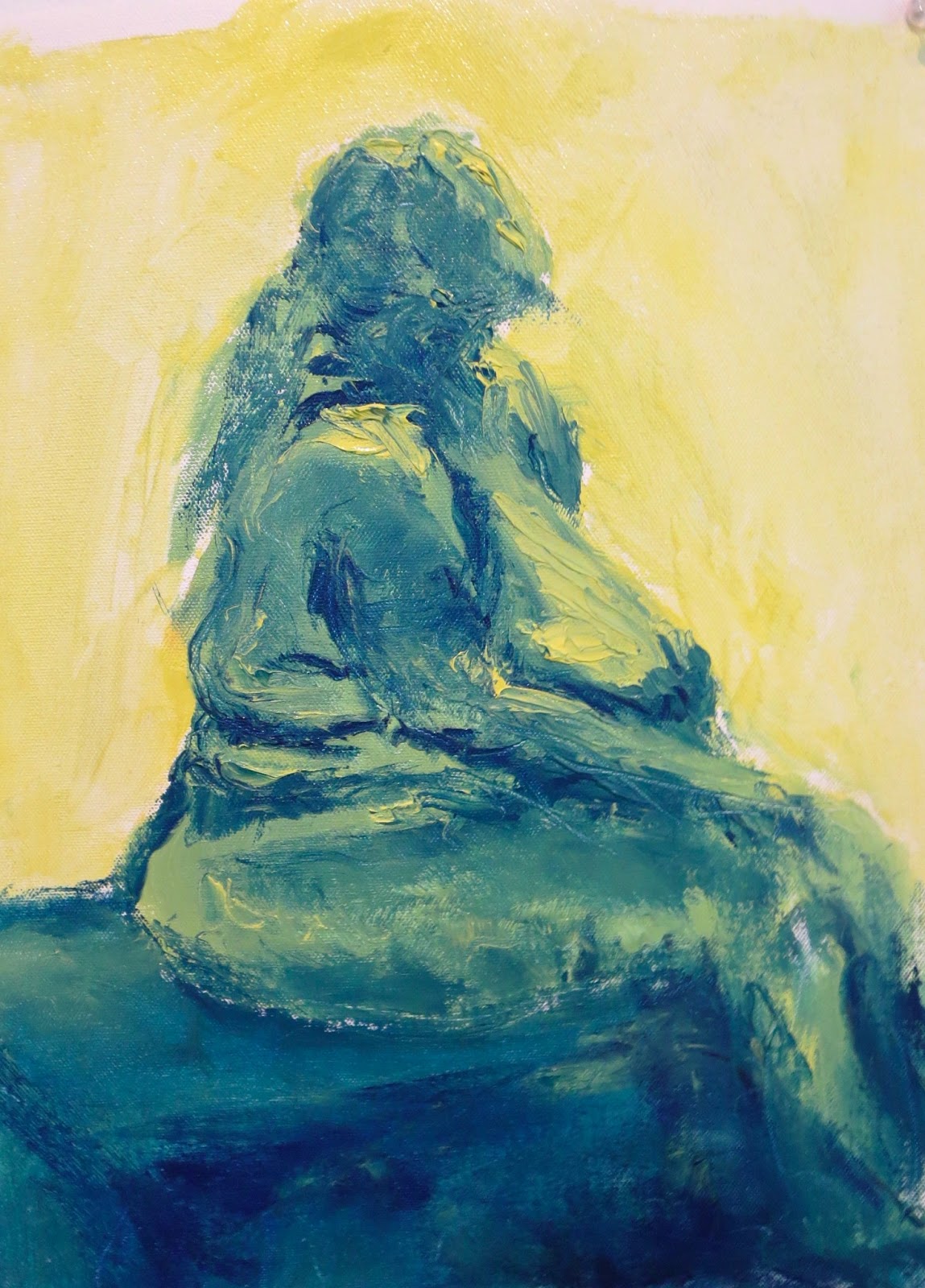
second day of figure drawing and a first for painting the figure | SIS l '13


Fear - like a thick, gelatinous poison - corrupts the process of making art. It creeps into every cavity of the brain, with its familiar rhetoric of inaccuracy and self-doubt. Paralysis sets in the longer one thinks. So limit the brain's activity. Instead of ten minutes, draw the figure in one minute. Instead of a whole day to paint, limit yourself to forty minutes. Then the marks become the focus. 


Camila

Irene

Ritu

Monique

Gavin

Irene

Monique

Dominique


June 26, 2012

the fourth week | SIS I '12

Some students had little or no drawing background. For others this class was one of many. Yet, when oil painting was introduced, everyone learned to fail. Out of the frustration - palpable by the second week - emerged a willingness to take risks with paint. And in the final weeks their individual viewpoints flourished. 


June 16, 2012

the third week | SIS I '12

Some students continue to use the figure, beyond the life drawing and painting sessions. While they further their skills and document the process, I barely get around to using my own camera. 


June 02, 2012

the first week | SIS I '12

After four days of drawing, it was time to start the painting process. (Let me rephrase that. There were only three days of drawing!) Here are just a few of the paintings that followed:


Daniela


Yue


Estefania P.


Alex


Here Garrett and Isobel are finishing up.


Site Meter